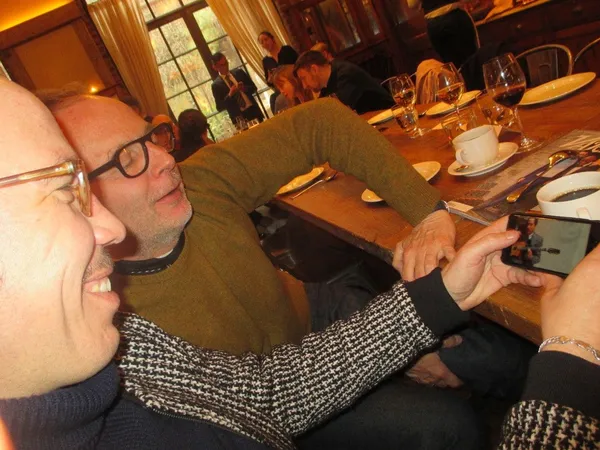
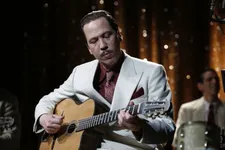
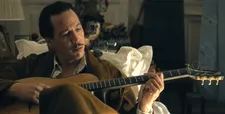
Reda Kateb enjoys playing Django Reinhardt for director Étienne Comar Photo: Anne-Katrin Titze
At the Rendez-Vous with French Cinema lunch, hosted by uniFrance, Reda Kateb gave me the connection between David Oelhoffen's Loin Des Hommes with Viggo Mortensen at the Venice Film Festival and meeting longtime Nick Cave collaborator Warren Ellis there, which led to composing for Reda's film Pitchoune and to Warren creating a requiem for Étienne Comar's Django.
Over really good coffee and delicious gelato at Robert De Niro's Locanda Verde in Tribeca, Reda told me about discovering Bimbam Merstein with casting director Stéphane Batut, insights with Cécile de France, spending one year in preparation, and Django Reinhardt's monkey Joko in the film.
On Django Reinhardt (Reda Kateb): "I didn't have an idea of him but I wanted to be him."
Django, based on the novel by Alexis Salatko, chronicles a crucial time period in world-famous jazz guitarist Django Reinhardt's life and simultaneously sheds light on the hypocrisy and contradictions at the core of Nazi policies. Admired for his musical genius, Reinhardt, because of his Romani background, also was a target of the regime. In 1943, he and his wife Naguine (Bea Palya), mother Negros (Bimbam Merstein), and Joko are aided by his friend Louise (Cécile de France), in an attempt to flee France and reach safety in Switzerland.
My conversation with Reda begins in Venice.
Anne-Katrin Titze: Your director told me that Warren Ellis was your addition to Django. You've worked with him before?
Reda Kateb: He's a friend of mine. Actually, I met Warren at the Venice Film Festival two years ago [in 2014].
AKT: At Venice for which film?
RK: For a movie called Far From Men where I'm starring with Viggo Mortensen.
RK: So we met there [in Venice] and we had a great connection. I like his work and I like him. Afterwards he helped me with the score for my short movie [Pitchoune]. When we talked with Étienne about the rewriting of the requiem from Django, I thought about him. So we made the connection.
AKT: It works well. It is fascinating that that piece of music is lost. It was played on the day Paris was liberated, right?
RK: Yeah. I think it was burnt. Another story of fire in the life of Django. Fire is like everywhere.
AKT: Fire?
RK: You know, it's because of fire that he was injured when he was 18. Afterwards the scores were lost because they were burnt. And Django, to get some quiet, he looked at the water, as you saw in the movie.
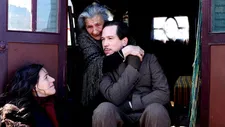
Django with his wife Naguine (Bea Palya) and mother Negros (Bimbam Merstein)
AKT: The fishing. How aware were you of Django Reinhardt before making the film?
RK: Like you. I knew a bit of his music but I didn't know so much about the character. I loved his music and I saw many pictures. I didn't have an idea of him but I wanted to be him.
AKT: I like that phrasing. It sounds a bit like an answer to the question What do you want to be when you grow up?
RK: I mean, I wanted to be him in the movie.
AKT: Of course, I understood. Did you practice a lot?
RK: I spent one year for the preparation.
AKT: That's more than for many other roles, I suppose. Did you ever play a character in a film about this period before? Set in the Forties?
RK: No, it's the first time.
AKT: The woman who plays Negros, [Bimbam Merstein] your mother, is very impressive. She is tough.
Reda Kateb shows me Django Reinhardt with Joko Photo: Anne-Katrin Titze
RK: She's the best. We met about one year before the shooting. With Stéphane Batut, the casting director, we went to the east of France to a gypsy community and we met the people in their houses. She made some coffee for us and told us some stories. And we made a kind of audition and I was very happy she was in the film.
She's a survivor of the Second World War. All her family was killed. So she brought a lot of truth on set. Sometimes during the breaks between takes, she took Cécile [de France] and me aside and she told us about her story. For her it was a kind of exorcism as well.
AKT: It's a brave choice by Étienne to mix professional actors with non-professional actors. And not to hide the fact. It's obvious.
RK: It's very challenging. We professional actors, we have to forget we're professionals. I think it's a mistake to think we are professionals. Sure, we learn some stuff, we have some technique, but we just have to "give the change to the people." It's a French expression I'm translating.
AKT: That doesn't work in English.
RK: Acting with amateur actors requires you to kind of be up to their challenge, to their standard, and to give them as good as you get.
Django Reinhardt with Joko: "I loved working with this monkey! He's a great actor, really." Photo: Anne-Katrin Titze
AKT: The other side of the spectrum - playing with the monkey!
RK: I loved working with this monkey! He's a great actor, really. I think he made more movies than me.
AKT: What movies was he in?
RK: Every movie they need a monkey, they call him. All the time.
Étienne Comar enters the conversation: Django [Reinhardt] had a monkey. There are people in charge of monkeys in the cinema industry. I don't know where the guy found it. It's a monkey.
AKT:Christophe Honoré told me that working with animal handlers was the absolute worst.
EC: Reda was amazed by the monkey. He loved it. Everybody in the crew was telling me - don't work with a monkey! It's impossible to work with a monkey. But Reda was absolutely fascinated by him and he was perfectly confident.
Read what Django director Étienne Comar had to say on telling the story of Django Reinhardt and working with Warren Ellis.
Read what Cécile de France had to say on working with Reda Kateb and the genius of Django Reinhardt.
 Facebook
 Reddit