
















































News and features

59th New York Film Festival early bird highlights Futura, Jane By Charlotte, James Baldwin: From Another Place and The Velvet Underground

2016
Effectively assembles footage and facts in a relentless barrage that just overwhelms you, while confidently establishing connecting threads that have terrifying implications.
The closer the glance at the specifics, the more universal the plight becomes.
Denis Villeneuve's latest film may be about aliens visiting Earth but it's the people who hold his interest.
The script takes an adult approach to emotions, even as it shows how childish a situation can become.
For many viewers, the film will require taking a step back, ditching assumptions and making a conscious effort to listen. It's worth it. These girls have a lot to say.
Full of passing vistas, moments of lyricism, raw sex and emotions – all building to a portrait of youths trying to bond together to survive.
Øvredal takes a handful of old tricks - a cheery song playing unexpectedly, lights blinking out in a corridor one by one, the tinkling of a bell - and uses them to chilling effect. The result is a film you really won't want to watch alone.
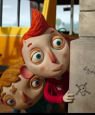
With imagery that shifts seamlessly from the kawaii to the diabolical, not least in a darkly psychedelic sequence near the end, this is a film that really makes its mark.
Parker's reductive approach, more concerned with creating a hero than depicting a man, means it never achieves the impact that it ought to.
You could make a film based on the achievement of almost anyone at the Invictus Games and you would be making Vinny's story
Koolhoven wants all voyeurism of an exploitation flick while still expecting us to take his artistry seriously, and it's an unholy mix.
Certain Women is a film suffused in uncertainties.
Though not entirely successful, Lee's adaptation certainly has balls.
Craig Shilowich's careful scripting avoids all the usual mental illness cliches and hystrionics to help us sympathise with her even in her most unpleasant moments.
Not a satire on the aspirations, colonial hangovers and intuitive racism of the Asian community in England's fraught and fractured land, but a detective story cluttered with high school nostalgia.
To assume it's just another routine serial killer yarn is to miss the emotional subtlety and sharp analysis of contemporary Japanese mores that underlie the greater horror.
We get to watch Lynch work on a sculpture, sit and smoke, or interact with his toddler daughter Lula in the present. Family photos and home movies light up the past.
Walker's performance as a woman mentally imprisoned by the strength of her own feelings is painful to watch, in a good way.
Dash gracefully binds together her connections and contradictions - the point where the past meets the present, where the decision to stay or go is made, where both belief systems can combine.
If this gang of ideas doesn’t quite hang together as it should, Benyamina still makes her mark with some brilliant moments.
Frank's energy, together with Israel's rapid fire editing, keep the film appealing, though they may leave some viewers feeling worn out.
In places it's very well scripted, astute and incisive, but for most UK viewers it simply won't translate.
This film is worth seeing simply for its National Geographic style snapshot of rural Mongolia.
There is a minimalism to this that compels.
Huppert's outstanding performance embraces with unswerving delicacy the controversial decisions she faces.
Magalhaes is superb throughout and perfectly in sync with the childlike perspective on events that Pesce brings us.
Frequently and not at all randomly, the film switches to colour, posing a charming riddle that reflects states of happiness or other kinds of intensity.
The director resembles a sniper who remains unseen, but whose presence can nonetheless be felt.
The film moves deftly between humour and poignancy, generating a strong emotional response in its quieter moments.
This is psychogeography, a place outback and beyond, where licit and illicit and moral and immoral are buried in shades of grey.
Cristian Mungiu is such a master of vivisecting human interrelations that we might almost overlook how he sets the tone with animals, vegetables and minerals.
The film shimmers and provokes where it is least expected.
One of the film’s leading forces is its stunning visual composition.
Kuosmanen constantly shifts perspective, asking us to view the situation from a different angle - and another place of emotional truth.
Anna Dorval as the transplant's recipient, Dominique Blanc's surgeon, and Emmanuelle Seigner's turn as the mother of the donor are all note-perfect.
Hell Drivers is a gem.
Even when we are ready to dismiss something presented to us as 'scientific' evidence, we are still ready to swallow a lie if it comes with an emotionally satsifying coating.
Indivisible is the best film to come out of Italy this year.
The Innocents may well be a historical film but it still has plenty of relevance today.
I Am Not A Serial Killer strikes rhythmic beats with precision as the story progresses.
The histrionics on display submerge everything else while the narrative pitch throws so much at the spectator that it is impossible to sympathise with anyone.
This film is not an encyclopedia entry but a living, breathing adventure ride into French cinema through the eyes and ears of the filmmaker.
Robert Greene's intriguing semi-documentary explores the event through a process not dissimilar to Chubbuck's own.
Kills On Wheels is a brutal and brutally funny thriller.
Morris is good but has to work very hard to keep us interested.
Dickson Leach makes good use of the countryside setting, to suggest the additional pressures that exist for farming families while allowing the environment to provide poetic interludes.
To its great merit, the film does not go for romanticizing or exploiting this child's life-threatening dilemma and the impossibly difficult decision-making process can be felt throughout.
Just when you think you know this story, Oldroyd and Birch begin to show you that you don't.
This film might wear its heart on its sleeve, but it is technically slick, well-acted, and laced with ear-friendly tunes. It is, in short, a proper musical.
As the voice of Gertrude, Tilda Swinton seductively pulls us in, reading her letters sent from afar.
This is a poetic documentary, a reverie, in which partitioned themes offer differing perspectives on the whole.
Reyes establishes a sense of the well-worn ritual that Lupe has acclimatised to, as well as showcasing the restraints on his existence due to poverty and his outsider status.
Ree embraces the music as a collaborator, a voice that can channel the feelings of both the character and the story.
Mauro Herce's cinematography is stunning and merges perfectly with the soundscape created by Emilio García Rivas.
There are strong, even hilarious, performances throughout.
Manchester By The Sea is a masterful study of clumsiness.
Allen's finest screenplay to date, filled with expostulating characters with relationship difficulties and hilarious interludes about the human condition.
Jenkins doesn't just show us the experience of his young protagonist, he bathes us in it.
Bayona knows how to turn the screw of sentiment, not so much jerking tears as gradually filling a well of sadness until it can't help but spill out.
The script has a heartfelt carefulness but it is never preachy, with 'naughty' conversations about the home's teacher's willy exploding likely to have pre-adolescents (and adults who well remember these sorts of conversations) hooting with laughter.
A triumphant piece of filmmaking.
It is in the second half of Nocturama - which takes place in a department store by night - that Bertrand Bonello's prowess at showing us worlds closing in on themselves comes to full force.
This is a study of bitter, sorry people hurting each other using ancient memories, propelled like bullets via the power of fiction.
Alexander Surkala’s sumptuous cinematography makes the place look endlessly beguiling and, intermittently, delivers us into the kind of darkness that can only exist in contrast with such light.
In keeping with the hagiographic tradition, Hamy keeps his performance rather flat, but this is problematic for The Ornothologist as a film; its success as a piece of art is somewhat at odds with audience appeal.
It is very well acted, with an explosively complex lead performance from Russell Tovey and an equally expressive supporting turn from Arinzé Kene.
After the initial disbelief that Jarmusch has written and directed a movie as simple and quiet as this, you settle into the rhythm of the piece and begin to appreciate the secret
Stewart valiantly tries to soldier through but cannot make her character spring to life.
You can turn it upside down, inside out and back-to-front and you might be able to work most of it out, but there will always be one thing that doesn't fit.
Poignant and funny.
Writer-director Alice Lowe takes a blowtorch to the picture postcard image of pregnancy.
Davies looks at questions of the soul, family, war, creativity and how to be true to yourself - all in stunningly beautiful images.
Some of the art is truly breathtaking, especially the star-filled skies, and the movement of the various animals we meet is beautifully observed.
The film's slow burn is gripping but, as it builds to a climax, the plot becomes overwrought.
Newley's acutely balanced performance lets us see the fear emerge in flashes as if he were coming up for air.
Too much smoke and not enough mirrors.
Oliver Stone takes the story and gives it slick mainstream polish, bringing the issue home in a way that is understandable and urgent, even if his hero ends up seeming almost too good to be true.
He may provide too much shock detail for some audiences but the director proves himself a master story-teller.
Kirill Serebrennikov takes a fearless approach to filmmaking, unafraid of blending intellectual ideas with realistic settings.
The humour itself is as light as a feather – a symbol used by Andeel in his animation to good effect – but the reaction from the regime(s) is about as subtle as a brick
Maitland keeps his balance superbly and ensures that this telling has the force it needs.
With their Day-Glo colours, singing and attitude to hugging, this is probably one of the few animations that will simultaneously appeal to the very young, any parents nostalgic for rave culture and grandparents who tuned in and dropped out.
A charming and entertaining take on the film within the film scenario, with solid performances from all of its cast.
The film really shouldn’t work, but it does.
The tensions are taut and the feelings genuine
Gillespie and Kostanski's real talents become visible when it comes to the special effects work, and here the film excels.
Everything is exquisitely shot and wonderful in its alienness.
There is less concern here with logic than with mood.
The phrase 'brave performance' is vastly overused but there's no doubt Stangenberg puts herself at some risk here.
McKellar delivers the huge chunks adeptly but there is simply monologue overload with little in the way of visual invention to lift it.
This is a lovely, joyful film from writer/director Makoto Shinkai that will, alternately, make you smile and have you perched anxiously on the edge of your seat.
This modern fairytale has its dark side, but it’s not as grim as something the Brothers Grimm would have concocted.
59th New York Film Festival early bird highlights Futura, Jane By Charlotte, James Baldwin: From Another Place and The Velvet Underground

Eye For Film continues to support festivals both locally and across the world. At the moment, we're covering:
Tallinn Black Nights Film Festival
Festival showcasing international and Baltic films
Thessaloniki International Film Festival
French Film Festival
The UK's longest running celebration of Francophone cinema

Search Movie Database
Search Eye For Film with Google