




 |
| ¡Que Suene La Banda! |
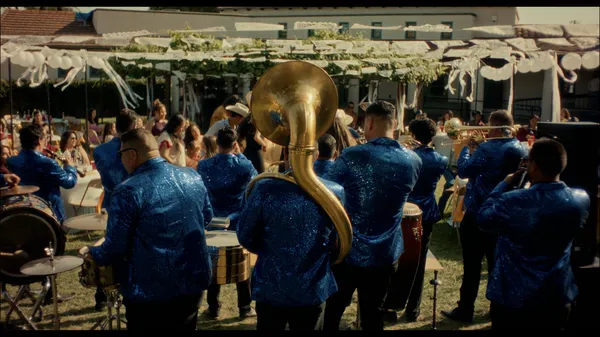
Talented young classical musician Javier (Anthony Gonzalez) is persuaded to join his father’s group playing banda music at a party in Jorge Parra Jr’s Oscar-qualifying student short film ¡Que Suene La Banda! It’s a decision that leads to bullying at school and prompts Javier to try to reject his roots, but conflict and unhappiness cannot prevail in a story that is full of heart. It’s a story, Jorge tells me, that he drew in part from his own life story.
“This served as my thesis film for my master's program at UCLA Film school. When it came time to really come up with an idea, I looked back at my own childhood, growing up, going to high school and being in the marching band in school. When I was in high school in the area I grew up, near LA – predominantly Hispanic, Mexican American – some of the kids in my class said ‘You know what? Let's start a banda!’ It's not the music I grew up listening to. It was my parents’ music, but I gave it a shot and I really fell in love with it.
“We had our first party performance and we started playing and everybody got up and started dancing, so I took that experience and I brought it to my thesis film. I'm like, ‘Let's do something with banda music.’ Right? Because we don't really hear a lot of banda in the mainstream media in the US. It's a lot of mariachi, typically. I love mariachi as well, but banda, there's something about the energy in that music. I wanted to tie it in with my relationship with my father growing up as well. As a kid you rebel and you try to distance yourself from your family's culture a little bit. So yeah, that's how that story came to be, and luckily we found a great cast, a great crew that really helped it come alive.”
Is the band in the film a real one?
“Yes, the band was a group that's actually local to the LA area. We got really lucky with them because of course they come with all their instruments, they come with the experience and everything. It's a very specific style of music and genre. You can't just have anybody with those instruments and expect them to look and sound great. And the musicians in the film that appear on screen were the ones that also recorded in the studio for the soundtrack, so that helped a lot.”
How did he cast the lead role? It’s difficult to find someone whose has that level of musical versatility as well as acting talent.
“The requirement that we had for the actor for the lead was he has to be a musician in some way,” he says. “The way we were able to really sell it onscreen was the sheet music. Anthony had all the positions for the trombone written on the music, so as long as he was able to read music and follow along with the music, he could position the trombone slide positions along with the music almost like a video game. Then we worked with a master's trombone student at UCLA who helped them to really sell the look: when to breathe, how to hold the trombone, the flick of the wrist and everything. So yeah, it was a lot of fun.
“Anthony was great with practicing at home and really feeling the music, and the other thing that we had to do was no matter how bad it sounded, we had to have him actually blow through the horn, produce some kind of sound. So he's following the music and making sound, and that helps sell everything from like the embouchure to the feeling and the movement when he's playing.”
At the moment, and certainly when it comes to films competing for Oscars, there’s a lot of work out there focusing on very serious subjects. It’s a moment, culturally, where a lot of people are feeling quite depressive. Is that partly why it was important to him to tell an upbeat story full of love and joy?
“Yes,” he says. “We filmed in 2024, so that was prior to everything going on currently in the US. We had no idea what was even ahead of us at that time, but we knew from the very start of making this film that we wanted to tell a positive story in some way. There's hints of the negative aspects of our society in the film. There's stuff about class and stuff about race, but it's embedded in there and we don't want it to overwhelm the story because at the end of the day it's about the family and it's about celebrating the culture. From the very beginning we wanted a light hearted story with a good message.”
There's also a point in the story where Javier is told that he shouldn't be using his experience of prejudice from people as an excuse for his own behaviour. It's very much about his own responsibility.
“Yes, exactly. And then, you know, learning to see the positive in everything. When his mother tells him about the joy that she sees when he's actually playing his father's music, I think he slowly starts realising that, and that's important for him as a good life lesson because at the end of the day, he may not actually go and be a banda musician, but it's something that he'll carry with him as he goes into classical or whatever field he chooses.”
We talk about the advantages he had in making this as a student project.
“As a student film, we were very fortunate in all the locations that we had. A lot of the sets were actually buildings at UCLA. For example, the music rooms, the hallways, even a recording studio that we ended up using for the soundtrack was all through UCLA. But as a student film, we take advantage of the opportunities that we get and the discounts. For example, the scene with the quinceañera, the big party, we got the non-profit discount for that location. It takes extra work to kind of find who's going to be able to help you out, but in the end, all that work is worth it.”
I tell him that I’m interested in how he handled the extras in the party scene, because everyone seems very relaxed.
“That was actually the very first day we filmed, and it was almost 90°F outside, a very warm July day,” he says. “Then again, it comes down to the planning. We knew we were going to have so many people on set. We knew we needed air conditioning, we needed water, food, everything, and that kept people happy because everyone stayed indoors. All the extras were new. We had games, we had stuff for the kids so they were nice and relaxed, and once we brought them outside in the heat and we actually started filming, we actually had the band start playing live music in between takes. People got up, started dancing and having a good time.
“For the extras, we put out a few notices on our community Instagram, just asking for volunteers, people who wanted to be part of this production. It was nice to see people from my hometown actually come out and participate and get a little part in the movie.
“We have a few people from my class that were involved, our assistant director and then people I already worked with that I'd met through the programme, including our director of photography, our composer, our production designer, our costume designer – they were all from UCLA. And then, through kind of word of mouth and people they’d worked with, we expanded our crew and we worked with a lot of the people that worked on my second year film. That was really nice because coming back together on that first day with that big party scene, we already knew a lot of the people, and it made everything go so much quicker and easier for us.”
There have been some really good responses to this film. Did he know when he was making it that it was something that might get that kind of attention?
“No,” he says. “It's always a pleasant surprise. I'll never forget we had one screening in San Diego at the Latino Film Festival, and I don't want to spoil it, but we had a reaction to the film that I had not expected. It was crazy because I think it was me, my producer and a couple other of our friends that were in the audience, Everybody else was people we've never met who had never seen the film, and to hear that collective response was pretty cool.”
He’s thrilled to be on the Oscar longlist, he says, never having expected to get this far.
“We qualified to do the New York International Children's Film Festival, when I got that email that we had won that qualifying award, I was in shock. Just even getting to that point as a student film, that's more than we could have asked for, so we're very happy.
“I think next is a feature. I've made my shorts, and I want to take that next step and figure out a way to get that done, whether it's adapting ¡Que Suene La Banda! into a feature or doing something different. That's my next goal.”