



 Facebook
 Reddit
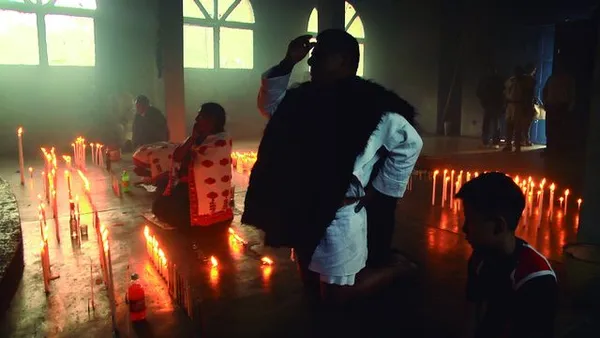
High in the mountains of Mexico, at Chiapas, Ch'enalv'o, among the Tsotsil, there is an elder, a spiritual counsellor, a keeper of traditions that are gently explored in this film. Manuel Jiminez Moreno is 'Bankilal' (eldest brother), a confident explainer of tradition, a practitioner of ritual, a keeper of faith. The beliefs depicted are a fusion, a fascinating one, of the Catholicism of La Conquista and the Mayan traditions that were found there, a synthesis of religions and ways of life that trace their histories back over millennia and whose strands first started ravelling centuries ago.
There are the actions of the tradtional way of life, the vocal embellishments of a particular style of chanting, the crushing of cane to make a fermented sugar drink, the head-dresses and fasting that accompany terms of service as a kind of mayoral lieutenant. There is the taxonomy of intercessionary figures, patron saints and junior and senior guardian animals, there is a candle shop in the village, there are the hills and the sky and the clouds.
 Not directly intervening in proceedings, Maria Dolores Arias Martinez' film may feature conversations that are reconstructed or just illustrate those on camera's awareness of watchers with a certain awkwardness, but not for all. Bankilal possesses an easy grace, a seemingly spiritual certainty that is indistinguishable from wisdom. Calmly, smoothly, he conducts ceremonies, offers guidance, harvests cane, drinks Coca-Cola, answers his telephone with its ringtone of the squealing of pigs. Over landscapes he intones explanations of belief, of visions of thorns indicating potential sickness, of the hierarchies of guardian animals, of carrying white men back from the thresholds of churches, of swallowing cassettes to record things in his head and in his heart. There are the prayers too, declarations and offerings, "it is impossible for a young person to beat us" he intones, a benediction upon new Paxonetics and a toast and a boast and a process.
At the end, appropriately, there is a re-telling of Revelations, an Apocalypse. All part of a gentle ethnographic survey, a portrait that (while simple itself) has found an intriguing subject. Due to a looped track in the sound system the audience at its EIFF 2015 Press & Industry screening will potentially always associate it with Arabian Nights from Disney's Aladdin, but that contrast between depictions of cultures is potentially illustrative. Eldest Brother is unhurried, as confident as its subject, and if it has a weakness it is perhaps the lack of context, of artifice - this is a camera pointed at something interesting to see, and while that's the core of good documentary, the best do more. A greater sense of place, perhaps, though the landscapes are fairly shown, or of time, though we see preparation and event, or even of age - but there's that contrast, the millenary and the mobile phone, the jaguar and the "thrice holy", and it's in its unhurriedness that, like its subject, it is most compelling.
Reviewed on: 20 Jun 2015

If you like this, try:
Review preview for Celestial Wives Of The Meadow Mari
All of it is so beautifully observed it is as waking from a childhood fever to demolish half a volume of Grimm before hallucinatory somnambulance washes once more over.
Review preview for Enraged Pigs
Perfectly contained, the contrast between human concerns and a cultural expression that's at once alien and untranslateable and immediately recognisable is stunning.
Review preview for María's Way
A gentle, touching, a portrait of a woman with a calling.