



 Facebook
 Reddit
This has a wider-scale and conventional narrative than Fassbinder's stark, arthouse offerings, such as Katzelmacher – but it still shows why no one ever gave dear old Rainer Werner the fluffy romcom gigs.
Opening with a tracking shot through a rundown travelling carnival on a rainy day in Munich, it offers (like Katzelmacher) a portrait of an outsider worn down by a society obsessed with conformity and bourgeois notions of ‘taste’ and ‘respectability’.
 Once again, Fassbinder plays the outsider, but this time he is the protagonist; Franz Biberkopf (nicknamed ‘Fox’) is the star attraction of the carnival, a young man who makes his living pretending to be a disembodied head, of which the crowd can ask any questions it likes. It’s a powerful (if somewhat obvious) metaphor for the character’s subsequent journey, where he becomes a dislocated presence on whom the other characters project their own hang-ups and anxieties.
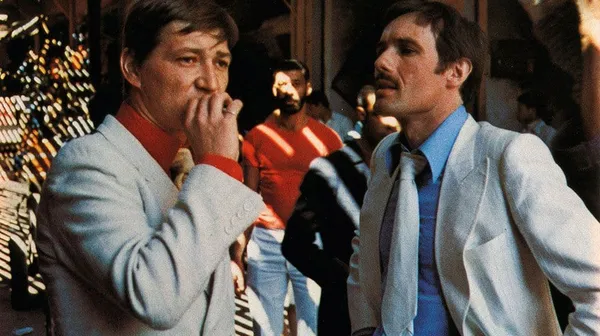
His circus career is brought to an abrupt end when the sideshow owner Max (Karlheinz Böhm) is jailed for embezzlement and fix is forced to stay with his alcoholic sister Hedwig (Christiane Maybach). Already on the fringes of Munich’s gay scene, he meets a series of well-heeled businessmen wishing to keep their preferences discreet. Among them is Eugen (Peter Chatel), a cultured aesthete with a boring day job at his father’s struggling printing firm.
Fox’s life ticks along uneventfully until his obsessional playing of the state lottery pays off. He wins half a million marks and immediately begins to live the life of a ‘demi-monde’ playboy; buying clothes from Eugen’s tailor, acquiring a swanky apartment and distributing largesse to all and sundry, particularly Max when he is released from prison and Eugen when the family firm is brought close to bankruptcy.
Signing a contract without really understanding the terms, Fox hands over a good part of his fortune to help the business out. In return Eugen and his family exploit and then discard him, setting him on a tragic path.
The satire against the conventionality and hypocrisy of West German society is here even savager than in Katzelmacher; Eugen’s family disapprove of his sexual orientation and are quite happy to take Fox’s money but make no secret of their disgust for him and take every opportunity to ridicule his table manners and like of appreciation for the finer things.
But it has to be said that Fox doesn’t make life easy for himself, using his new-found wealth and status to play power games with his ‘friends’ (the title, as you may have guessed, is not without a fair degree of irony) and shrugging off the fallout of his catastrophic attempts to lend a hand on the factory floor.
Once again, the quality of the writing, editing, cinematography and everything else is top-notch, but it’s undoubtedly a bleak, hard watch; about the only comic relief is the parade of ‘Life on Mars’ style fashions and hairdos, proving that Britain wasn’t the only place where the 70s was the decade that taste forgot.
At the time of its cinema release, the film attracted criticism from gay groups who complained of ‘stereotypical’ negative representation. It’s true that the supporting cast contains its fair share of bitchy, ageing queens and heartless, petty young things. But the fact is that all the characters, gay and straight alike, are a flawed and unlikeable bunch.
Watching this and Katzelmacher in quick succession I came to the conclusion that the openly gay, openly drug-taking Fassbinder had a touch of the hard-line Calvinist in him; basically, he wanted to damn them all. Fair enough, but new readers should be warned; his unblinking, existential vision of human life is definitely not for the faint-hearted.
Reviewed on: 13 Nov 2007

Related Articles:
Fresh Fokus on German filmIf you like this, try:
Review preview for The Rainer Werner Fassbinder Collection: Commemorative Edition Volume One (1969-1972)
A comprehensive look at the earliest of Fassbinder's films
Review preview for The Rainer Werner Fassbinder Collection: Commemorative Edition Volume Two (1972-1982)
One of the leading lights in New German Cinema.