
'I wanted to write a story about absolute, unconditional love'

Rosalie director Stéphanie Di Giusto on her bearded lady with a feminist message

by Richard Mowe

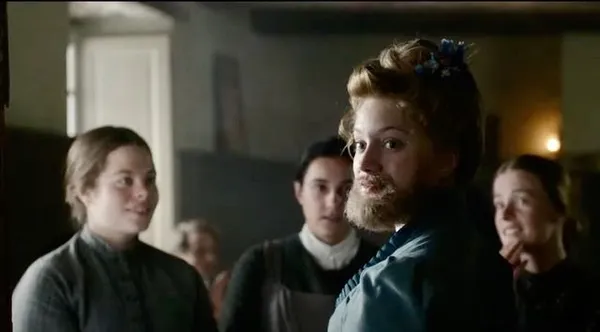
Stéphanie Di Giusto on Nadia Tereszkiewicz in Rosalie: 'Nadia immediately and fully adopted the beard. It was carnally evident'
Stéphanie Di Giusto on Nadia Tereszkiewicz in Rosalie: 'Nadia immediately and fully adopted the beard. It was carnally evident' Photo: Gaumont
In her two films to date director Stéphanie Di Giusto has uncovered two extraordinary women. For her debut feature The Dancer (La Danseuse) the subject was Loïe Fuller, a farm girl from the American midwest, who revolutionised theatrical movement and the stage arts at the end of the 19th century. It bowed to acclaim in Un Certain Regard at the Cannes Film Festival in 2016.

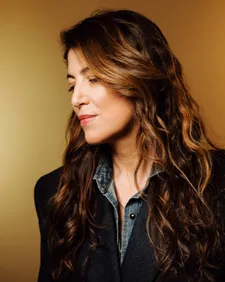
Rosalie director Stéphanie Di Giusto
Rosalie director Stéphanie Di Giusto Photo: Marie Rouge for UniFrance
Now eight years on she offers another female discovery for her second feature Rosalie, about a young woman in 1870 France who is born with a face and body covered in hair. Rather than become a fairground “freak” as a bearded lady she strives to be seen as a woman despite the obvious difference. It also screened in Cannes in Un Certain Regard last year.

Di Giusto confesses that after her first film she wanted to take time out to write. It’s the period in the creative process when “everything is possible and when you feel free”.

She felt inspired by famous bearded woman Clémentine Delait, who actually existed. Di Giusto concocted a fiction around the character (played by Nadia Tereszkiewicz) who manages to hide her secret from her husband Abel (Benoît Magimel) until their wedding night.

After his initial revulsion she tries to regain his affection by using her appearance as a curiosity to boost the clientele of their bistro, which proves to be their financial salvation.

“I came across photos of the woman and her bearded face fascinated me,” said Di Giusto. “Rosalie is emancipated but will have to stand up to others and affirm her strange femininity against the prejudices of an era. What is the meaning of desire for a woman like Rosalie? And still more fascinating: can a woman like her be desirable? I loved filming her female face and body, that eroticism between grace and animality. And it’s true that there are lots of resonances in the film with identity and women’s roles and preconceptions of femininity.”

“For me, cinema begins when we are fascinated by a poetic presence, when the clock stands still, untouched by time. When an image becomes poetry… or cinema... Each film is a response to the time in which we live today. A way to survive the world around us. I think that love today has become a struggle in a progressively dehumanised lifestyle. That is Rosalie’s combat. Loving someone else, loving herself. I wanted to write a story about absolute, unconditional love.”
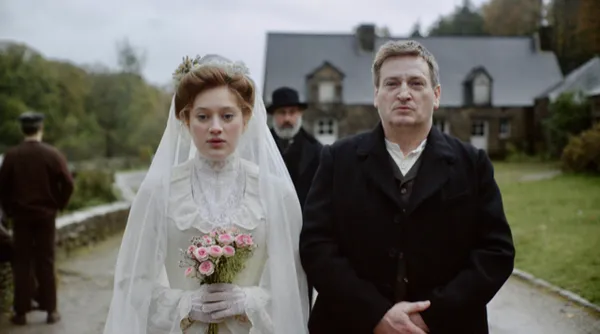
Nadia Tereszkiewicz and Benoît Magimel in Rosalie. Tereskiewicz says of Rosalie: 'There was no other option but to plunge completely into the character and the way she looks'
Nadia Tereszkiewicz and Benoît Magimel in Rosalie. Tereskiewicz says of Rosalie: 'There was no other option but to plunge completely into the character and the way she looks' Photo: Gaumont
She had worked with Nadia Tereszkiewicz on her first film when she played a young dancer in Fuller’s company. She ran in to her by chance in the street at the time she was casting and asked her come for a screen test. “She was one of the rare actresses who did not look afraid. No theatrical affectations, which would be understandable when being asked to play a bearded lady… Most of the other candidates kept looking in the mirror, bewildered. Others kept scratching themselves… But Nadia immediately and fully adopted the beard. It was carnally evident. I had no doubts as I watched her act. She had an actor’s pure energy, and the natural enthusiasm I needed in the character. Even with the beard, she exuded something troublingly sensual.”

Tereszkiewicz found that the character touched her deeply. “The moment when she accepts her beard she becomes a woman with her own sexuality and her independence. Questioning what is femininity is a very strong theme in the film. It considers the place of women in society and asks what defines us as women. As for preparation, there was no other option but to plunge completely into the character and the way she looks. It took four hours every morning to get all the make-up done - every hair had to be glued on one by one. The first time I saw myself it was quite destabilising.”

Di Giusto explains that she did not want to cheat and use a cheap hairpiece “That meticulous, obsessive work helped Nadia to possess the role completely, carnally. I treated Rosalie’s body like a sculpture, strange and desirable. The idea was to create a second skin that the actress put on every day to feel its ‘weight.’ That decision stimulated me on a daily basis. That is the miracle of cinema, making believe, making something unnatural look natural, revealing the poetry in something that seems devoid of it.”

After these two extraordinary women where will Di Giusto’s attention land next? “Perhaps on a man,” she said with a laugh.

Rosalie is on release in the UK from 7 June.

Share this with others on...
News

Expanding the possible Fernanda Salgado on fantasy, reality, Jan Švankmajer and Ana, En Passant

A burning thing Sneha Mehta and Teddy Stern on falling in love with Mumbai, and making Getar Hero

Nothing is impossible Paul Rowley on moving to New York, the Pulse massacre, and Gays Against Guns

‘The only thing that makes a story universal is emotions’ Warsaw’s Industry panel discuss reaching audiences abroad

The only thing worth saying Chuko and Arie Esiri on adapting Mrs Dalloway and making Clarissa

European Film Academy shortlist announced 68 features vie for nomination

More news and features

We're bringing you all the latest news and reviews from the London Film Festival and Newfest.


We're looking forward to the Belfast Film Festival, Halloween Frightfest, the Cheltenham International Film Festival and the Leeds International Film Festival.


We've recently brought you coverage of the New York Film Festival, Grimmfest, Beyond Fest, the San Sebastian International Film Festival, Fantastic Fest, the Toronto International Film Festival and the Venice Film Festival.


Read our full for more.


Visit our festivals section.

Interact

Don't forget that you can follow us on YouTube for trailers of festival films and more. You can also find us on Mastodon, Instagram and Bluesky.


It's a busy time for festivals and here's the latest:


London Winners announced


Tallinn Black Nights UK co-production joins Works In Progress


Warsaw What Belongs To Others takes top prize


Tallinn Baltic Competition, Rebels With A Cause and Critics' Picks titles announced


Dinard I See Buildings Fall Like Lightning named Best Film