Rafael Manuel on identity, consumption, exploitation and Filipiñana
by Casper Borges
Filipiñana
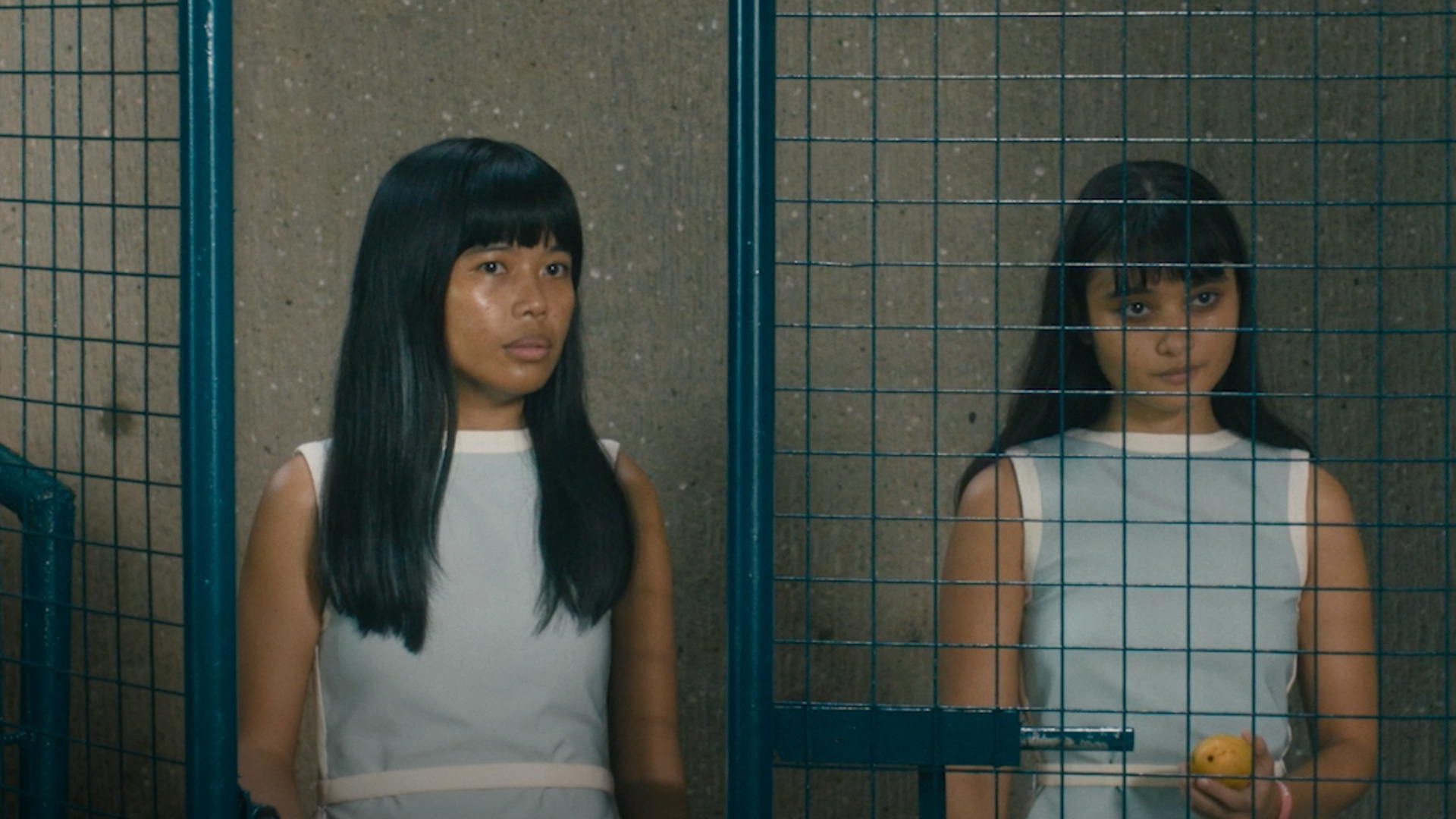
Director Rafael Manuel's steadily paced and atmospheric feature début Filipiñana offers a different view of the country than one audiences are accustomed to seeing. Set over a sweltering hot day, the story follows Isabel (Jorrybell Agoto), a tee-girl at a luxurious golf club in Manila who is trying to pick up the rules laid out by the club's strict hierarchy. Meanwhile, another young woman, the wealthy Clara (Carmen Castellanos) plays rounds of golf with her uncle, Dr. Palanca who is trying to convince her to move back to the Philippines.
Speaking with Eye for Film, Manuel discussed the juxtapositions between his two characters, and how he imagijed Filipiñana as a story beyond class conflict.
Casper Borges: When you first set out on to make Filipiñana, could you have imagined where it would lead?
Rafael Manuel: No, never in my wildest dreams. Just having a US and a UK release, growing up as a filmmaker in Southeast Asia, these are territories that you don't necessarily think about, because the more conventional route is the European art house route. But it's really a pleasant surprise to see how much this film is resonating in the English-speaking or Anglo Saxon world.
CB: Why do you think that is?
RM: Well, golf for one thing, which is a very Anglo thing in many ways. The first golf courses in the Philippines were on American military bases and considering that it was the British that introduced the game to the Americans, maybe that makes some sense why it tracks in the Anglo Saxon world. Also, another thing referring back to the European art house world, is for better or for worse, they have a very particular view of the cinema that comes out of Southeast Asia. And this film is not that, it's a counterpoint event. So, because there are less examples of Filipino cinema or Southeast Asian cinema in America, the UK and the Anglo Saxon world, they're more open to different portrayals of Filipino and Southeast Asia.
CB: So, it was intentional to lean into juxtapositions to counter audience expectations?
RM: Yes, and you see that in the juxtapositions of the first scene to the rest of the film. It was intentional to start the film in the crowded and impoverished streets of Manila. It's an image that maybe Europeans, the west and the global north are used to seeing. And then as soon as the title card comes out, we cut to a pristine golf course. That was our way of saying yes, that is the Philippines, but so is this.
CB: We have a way of creating these tidy definitions that is a means of simplifying to make understanding the said thing or communicating about it easier. We see this happen with cultures all the time, where they are understood through the reductive practice of stereotypes.
RM: Did it start with Aristotle and the classifications of things: the genomes, the species names, and being able to classify things having dominion over other things. When you talk about man's dominion over the world, film is a very good example of that, in terms of how something about a particular region is represented, exported and consumed. And I think the Philippines deals with a lot of these themes in terms of dominion and gentrification. What is a golf course but dominion or gentrification over land? You're taking something that's wild and you're manicuring it, making it safer and comfortable for human inhabitation, enjoyment and consumption. So, for me, this is a film that very much takes place in a golf course in the Philippines, but I've said this before, it could be a shopping complex in Dubai or a high street in London.
CB: Picking up on your point about dominion, there's a scene early in the film where a round of golf is held up, and a specific reference is made to the trees and how they could be replaced. It made me think of the human footprint and how as human beings we habitually think we know what's best for nature. Regardless of our class status, we forget that nature is on its own journey — ignorance doesn't know such boundaries.
RM: You very much hit the nail on the head. It's an anthropocentrism/human centrism and I guess human ego. And that's why I'm very much against this film being read in an oversimplified class war trope. I mean, yes, it's a class war, but it's war within the classes as well. It's not just rich versus poor, man versus woman. It's man versus man and woman versus woman. It's just human beings exploiting other human beings and human beings exploiting the Earth.
My favourite example is [Rainer Werner] Fassbinder. The films he was making in the Sixties and the Seventies, there would be the temptation today to call them queer films, but back then, it wasn't just limited to that. They were films about human beings exploiting other human beings for love and emotion. And, for me, that's a more dangerous thing.
And as we go forward as a race, the more and more labels we come up with, when you erase all of that, we're still trying to solve the same problems that we were trying to solve back then. These labels are just band aids; they're dressings.
For me it's like going back to gentrification and dominion. If a group is happy to be labeled and sees their entire identity in a label, are you seeing your entire identity in the assimilation into a society that you are or you were already unhappy with? The whole point of queer theory was that it's a counter theory. You're meant to be counterculture but for you to then be assimilated into the mainstream, that's not what those guys were originally about — it's not a counterpoint.
CB: Even for outsiders or people on the fringes, they often have a tribe they belong to. Only, there's a romanticisation of not belonging that compels denial. Also, you look at the appropriation and commercialisation of the 'nerd' or 'geek' identity', that is a counterculture that has dramatically changed. So, a question for certain characters in Filipiñana is about empowering oneself no matter the external pressures.
RM: For me, playfulness and resistance are such a main theme, not just in the finished product, but also in the making of the film: how I dealt with the actors, and how they dealt with me. And despite all the minimalism of the action and of the plot, there's a playfulness in the film that acts as a resistance to all the parameters, and all the formalism that the film introduces.
CB: What was the genesis of the idea for Filipiñana?
RM: When I was at the London Film School six or seven years ago, I always knew I wanted to graduate with a graduation film that was set on a golf course. It's a world I know quite intimately, and my parent's business has to do with importing and exporting golf apparel. And so, from a very young age I knew this world. I grew up in this world and I guess the whole genesis of the idea was the image of a tee girl in between a golfer's legs. I think that image alone effectively communicates the power dynamics, the socioeconomic relations, and the gender relations that are intrinsic to this world that I grew up in. It was only when I moved further away from this world that I started to pick up the nuances of what made it so absurd.
CB: Previously you spoke about Filipiñana not being about class. Is this a patient transition, from leaning into class while you slowly peel away the layers to reveal broader themes lie beneath the surface of the film?
RM: That's something that maybe is not so apparent in the short because of the time constraints. With the feature, I think we're given the opportunity to explore more holistically the milieu, and to have the counterpoint of Clara and Isabella, which I think is a very important counterpoint in the film. If you notice, the first image of Isabel that you see is of her opening her eyes. And the last image you see of Clara is of her closing her eyes. It's a very conscious and intentioned mirror in that Isabel's is a journey into awakening and action, whereas Clara's is a journey into slumber, into passivity, and inaction.
And what they know consciously evolves throughout the film. Isabel knows in her gut that there's something about Dr. Palanca but. she can't quite put her finger on it. She resorts at first to the common trope, which is an infatuation, a crush, or something easier like they're both from the same region. And so, this is what draws her to him initially. But then as her journey goes on and she discovers more it becomes a journey into her memory. And this is very conscious as well, because as a people collectively, the Philippines has a very short term societal collective memory. This is demonstrated in the fact that politicians are usually rinsed and repeated, despite all the unhappiness that the people feel toward their politicians. It's always repetition, whether it's them, their sons, their daughters, their nieces, their grandfathers, their brothers, their sisters.

 Facebook
 Reddit