


 Facebook
 Reddit
The erosion of traditional life in rural areas is a subject that is cropping up with increasing frequency in documentaries. From one of the last Macedonian wild beekeepers in Honeyland to the Lebanese farmer in The One Man Village, Icelandic sheep farmers in The Last Autumn and the Romanian crofter in Where We Used To Sleep there are tales of climate pressures, land development and economic drivers that lead to depopulation.
With To Kill A Mongolian Horse, first-time writer/director Xiaoxuan Jiang draws on the real life story of her star Saina - playing a character of the same name - to explore through a fictional framework how similar drivers are impacting life in Inner Mongolia, an autonomous region of China with its own specific language and traditions.
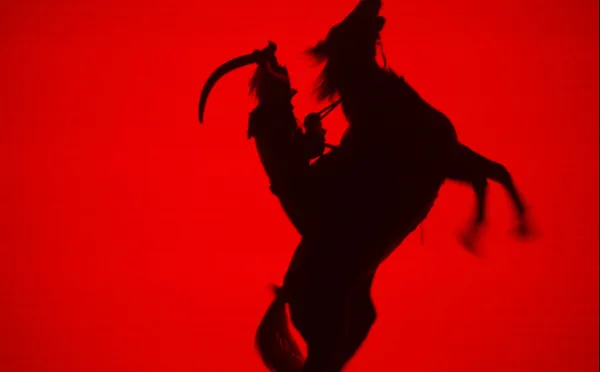
 Saina is an incredible horseman, a bond that we see in every interaction with his ageing white stallion. Once a successful racer, he now works part-time alongside his old friend Hasa (Undus) in a historic extravaganza, performing impressive, if dangerous, horseback tricks for Chinese tourists. His life is split between these evening displays - which have a mythic quality and play out against striking red and blue backdrops - and returning to the modest rural homestead he shares with his father (Tonggalag). Problems on the homefront include his father, who drinks and has got them into gambling debt, and extend to grazing issues caused by climate change. Adulation is also thin on the ground from his ex-wife Tana (Qilemuge), with whom he shares a young son.
What emerges is a carefully calibrated, bleak but elegiac picture of an environment where people are being forced to perform rather than allowed to live on their own terms. Beyond the night-time shows where Saina rides, there are also ranches where tourists are greeted by ersatz traditions and even Tana finds herself called upon by her boss to sing on demand. People are selling their herds with a view to moving to the city, but the question of what happens if they have to come back, hangs in the air. Even a local riding school is passive aggressive about Saina’s skills since they teach “proper” western equestrianism there.
Jiang has an eye for balance both in story and in framing. Saina is perfectly caught between the two worlds he partially inhabits, unsure which way to jump. The framing balance, meanwhile, notably shows father and son mirroring. In one scene, Saina’s outline becomes overlapped by a reflection of his father, while in another one man is in light and another in shadow. Later, Tao Kio Qiu’s camera drifts through a room so that we can see Saina in one half of the frame while his son is reflected in a mirror as he plays in the other half. The director also shows she has some chutzpah when it comes to a drone shot - often overused in modern cinema - by incorporating its deployment as part of the narrative arc.
This is a film less about choosing a road to follow than about being bulldozed down a specific path by circumstances and a sort of cultural colonialism that is only interested in tradition as an entertainment not as a way of life.
Reviewed on: 02 Sep 2024

If you like this, try:
Review preview for City Of Wind
Purev-Ochir gives a sense of the pressures the younger generation are under through their experience in the classroom, with a tacit implication that Ze’s struggles are reflecting a spirit of a nation.
Review preview for The Rider
The craft, the knowledge, the deep communication with the animal, shown without words - this is breathtaking, transcendent cinema.
Review preview for The Shepherd
Money, as the old saying goes, is the root of all evil here, not just because of inherent greed but because of the way it permeates through relationships, poisoning as it passes through.
Review preview for Tharlo
Tseden takes an austere approach to framing, from the crisp black and white lensing of cinematographer Lu Songye to his long, fixed camera takes, with Tharlo almost always present.