





 |
| Mum, I'm Alien Pregnant |
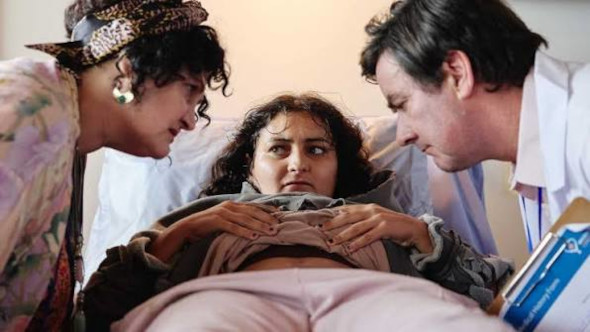
One of the surprise genre hits of the year, Mum, I’m Alien Pregnant has been a smash on the festival circuit. Just out on digital, it’s part of a long tradition of New Zealand/Aotearoa horror comedies mixing deadpan humour with lashings of slime and gore – but, some viewers have noted, that’s often what pregnancy is like. It was itself conceived by the duo known as Thunderlips, aka Jordan Mark Windsor and Sea Wallace, who have an alien infant in tow when we meet for a chat. As Jordan settles her down in a corner of Sean’s couch, I ask if they had any inkling that their film would be so popular when they started making it.
“Well, yeah.” Sean laughs. “When I read the first draft of the script, I was like, ‘This is amazing! We have to make this, but no one will let us.’ That's been the big shock for me, that at every stage people keep saying ‘Yeah, this is great, you can make it,’ despite how batshit crazy it is.”
“I have the opposite answer,” says Jordan. “I am shocked. I mean, I thought it was really good and I loved the movie, but I thought it was maybe for New Zealand, you know? Then we got into Sundance and festivals all over the world and I'm baffled. Do they even understand the accent? I thought this was a local movie. I guess it's not.”
It did feel a very New Zealand film, I observe. I was reminded of some of the early films of Peter Jackson, particularly by the baby’s hapless father, Boo, who seemed like he could just have wandered out of one of those films.
“Yes, I bet he could,” Jordan agrees. “He even acts a little bit like he's in Bad Taste. One of the characters [Derek] gets lobotomised or something. He has a brain injury. He's played by Peter Jackson and he does do some of the affectations, the wandering around looking a bit clueless. I can see that.”
But it's also something that a lot of new dads or dads to be do. An awful lot of people who've been through pregnancy, either directly or as partners, will relate to the film in that way.
“Yeah, yeah,” says Sean. “That's been a lovely surprise. It hasn't just been genre fans. It's really meant a lot to a lot of people who have been through pregnancy or who really don't want kids. It’s not judging anyone.”
People keep telling the heroine that she’ll change her mind and want the baby, but plenty of people share her lack of parental urges – we just rarely see them on the big screen
“Well, yes,” says Jordan, “but we actually felt it in a strange way because we were told when we had written the screenplay that a character needs to change. She starts off not wanting the kid, so good screenwriting would dictate that she changes her mind. We have people in our lives who do not want to have kids, but that normalised that for us, and we can see there's a hole in cinema that's shaped like that for sure, but it wasn't quite that intentional. But it was strange that when we tried to make the movie, we came up against some of the conventions of cinema itself, trying to convince us that the character should change her mind. And we were always staunchly against that.
“We were like ‘No, I'm sorry if that makes the movie a little bit worse. We have to make a slightly worse movie because that's this character. She's not going to change her mind.’ And it was actually after we had done the first cut of the film that we realised that the audience was still wondering at the end. We were like, ‘No, we settled that.’ And then we realised, ‘Oh, we have to shoot a new little piece to go on the end of the movie, just to reiterate that she's not going to change her mind.’ That was one of the last things people were wondering about at the end.”
I suggest that this so-called good writing makes films rather dull and predictable.
“And those movies, those stories have been told,” he points out. “We've all seen ‘Oh, she changes her mind. She wants to have the baby.’ Fine. That's okay, because that is some people's experience, but I always hope that we have something to add to the conversation that is cinema.”
Did they start by going through what happens to people in pregnancy and seeing what they could do with the worst parts of it?
“No, he lived it,” says Sean, nodding in the direction of his friend. “The research was a primary source.”
“Yes. My child's mother and I went through some harrowing stuff with doctors, especially, because our daughter was breech – she was upside down,” says Jordan. “It was just amazing to me how callous and dismissive some of the medical professionals were around that. But then when it came time to write the movie, it's all right there. I guess if you're familiar with the process, there are certain things that just leap out at you. You know, things like getting weird rashes and mastitis and stretch marks and, obviously, the awkwardness of suddenly changing shape. But then there's stuff like the placenta.
“You know, if you give birth, you have a relationship with the placenta that movies seem to ignore. In movies, they pop out the baby and they're like, ‘That's all done,’ you know? I'm like, ‘There's other stuff!’ And contractions, you know, fascinating and incredibly relatable common experiences that because of their relationship to birth and things that are considered, like, ‘feminine’ things, they don't get talked about so much. But I think if you look at the human process or the mammalian process – because all mammals go through this stuff – if you look at that process, things leap out at you and they just automatically become parts of the movie.
“Obviously, other stuff is based on the characters and what they're trying to achieve in and of themselves. That'll take the movie in its own direction. But the biological stuff, yeah, that's all just based on human stuff, and that's why it's so great when some people see the movie and they go ‘Yeah, it's a documentary.’ I love that.”
One of the jokes that runs throughout the film is the idea that the heroine can insist that she's alien pregnant and everyone just ignores that part or treats it as another little quirk of pregnancy – though the plot suggests that at least one person has been alien pregnant before her.
“We always think that was under wraps,” Jordan says. “We think she did that in total secrecy. There is something about New Zealand. I actually walked over here this morning, to Sean's house, with this alien baby on my arm. I walk past people and they would notice something, but then no comments – they would look away. They’d just carry on with their day. I think we have an especially blasé culture here in New Zealand where that comedy and what might seem like quite a strange attitude comes from.
“If someone was alien pregnant here, it wouldn't be like it is in ET. There wouldn't be news cameras, and the house wouldn't be put in a bubble. People would just be like, ‘Oh, yeah, get on with it. You'll be alright.’ That's actually how we are as a culture. I think that's hilarious, because you don't see that in cinema either. ‘I don't really care. Okay, your baby’s an alien. Whatever.’”
We talk about the special effects.
“From the start, we always wanted to do everything practically,” says Sean. “That's our background in music videos, because we never had any money or the skills to do stuff with CGI. Also it's like that tradition that we talked about, with Peter Jackson and the people that came before us who worked with puppets and in-camera special effects.
“It was really fun and also really difficult, and it got progressively more difficult because we shot the film chronologically, which was such a luxury. But it started off with people in kitchens drinking cups of coffee and being our first movie, it was all new to us. And I was like, ‘Oh, is this how easy making a movie is?’ It was such a lovely time. And then when we started adding in the nest and the baby and the penis, everything got much harder. In those moments, I was very glad there were two of us to get through it.”
“When you're working with practical effects, you've got the shot set up and you're shooting for five or ten minutes just to try to get two seconds that look believable and kind of work,” adds Jordan. “That's hard. That's so strange.”
“We were well resourced,” says Sean. “We had a whole team from this company called Scale Studios who were amazing. And even then, stuff works, like, half the time.”
On top of all this, they shot it all inside a tiny flat.
“We didn't have any money for sets, unfortunately,” says Jordan. “We actually wrote the feature film first and then in order to try to get the money to make the feature film, we adapted part of it into it, just to convince people that we wouldn't mess up the drama, the acting and all that stuff. Our background is music videos, so they were like, ‘Oh, but what do you know about working with actors?’ And so we had to make this little short to prove ourselves to the distributors.
“When it came to making the movie on the international scale, our budget was minuscule, so we couldn't afford to do any sets. Although people told us that putting the alien nest itself inside one of these tiny flats was lunacy, and that there wouldn't be any room to move, and they were100% correct, we did do it that way. We just made that nest in pieces and then brought it in and finished building it in the room, and everyone had a nightmare of a time trying to step around it.”
“When you see the inside and the outside side, it's the same thing,” Sean points out. “We did get a pick-up in the studio. We didn't quite get enough little detail shots. We couldn't get back into the flat, obviously, so we did these pick-ups in a studio and everyone was like, ‘Why did we not do the film like this? This is so nice.”
“It was,” Jordan agrees. “We're like, ‘Oh, is that how filmmaking works?’”
“Sets,” says Sean dreamily..
Jordan nods. “Wow, Easy.”
There’s another detail that he’s keen to note. “The character cannot get space from her own mother. There's a claustrophobia relationally. To then be stuck in this flat together, both children and their parents in a small flat. And so that was the thing. We were like, ‘We're just going to have to suffer because that's part of the story, is you're stuck in the tiny room.’”
We go on to discuss the film’s festival success.
“It was a roller coaster initially,” says Sean, “because you usually have a plan for the film. And were going to finish the movie in about September and it was going to go straight to TIFF in Toronto. And then we sent it to TIFF early on, like a rough cut, and they were like, ‘Nah, we don't want it.’ It was quite dejecting. We were like, ‘Oh, did we not make a good movie after all?’ And so then we had like our second tier options, but there was this always this Hail Mary of Sundance, like, well, maybe in some crazy world we'll get in.”
“Yeah, but no one dared to hope,” says Jordan.
Sean grins. “And we did. The right person saw it at Sundance and it resonated with them in a way that it didn't quite resonate with the TIFF guy. Maybe he hasn't had kids or whatever, but the right person saw it.”
“Since then we've just been taking it around the world and it's been really interesting to see what different audiences laugh at, says Jordan. “Like different flavours in the different countries we've been to. The audience in Utah, at Sundance, was a bit older and it really cared about the relationship between the adult kids and their mums. And then in Canada, we went to Montreal and they loved the gore. Anytime there was slime or alien penis or whatever, they were cheering. They loved that in a way that the Utah audience didn't at all. And then when we went to Australia with the movie, they loved the colloquialisms. In Australia, they really like making fun of Kiwis, and for them, it was all the local stuff that other audiences didn't get at all.
“The Australian audience went nuts more. It's been a real privilege to go around these different festivals. So many people show up for a festival that probably wouldn't show up if the movie was just in the cinema. You know, it's an event, and we love seeing the movie with a full house. That's the greatest joy, because you get to be embarrassed together and hear each other's laughter. That's such a treat.”
So where do they go from here as filmmakers? How does one follow up something like that?
“There's a lot of pressure that is sort of put on when you go to a festival like Sundance as directors,” says Sean. “There's a momentum thing you want to ride, because next year is going to be a whole another hundred movies going there. The reality is you need, like, five or six different projects, and you keep talking to people, and eventually something will click into place. But we don't know when that will be. And we're trying to not put the pressure on ourselves to rush that because we want to make sure that the next project is something that we love. Jordan's writing a script right now. I'm doing another draft on another script. We've got a couple of other things. We don't know what it'll be, but it will be amazing.”
Do they see themselves doing similar work in future, or something totally different?
“No more effects!” he says emphatically. “Alien Pregnant was a great first movie because, you know, it's a genre film. You don't need name stars for a genre film. It’s a really good space to get your first movie on the ground. But it's not necessarily a space we want to keep playing in.”
“It's all based on the script, though,” says Jordan. “You know, if we wrote a script that we loved, or if someone else had a script that we loved and it was in that space, we would never say no to making a movie, really. If it's actually possible, we just love making it, and it's really good. Yeah, we'll say no if it's not. If it's great, we have to try to make it.”
“But our next one potentially could be a surrealist crime caper that turns into a slasher film,” says Sean. “We love messing with genre and stuff, like horror comedy kitchen sick drama. All of these things smashed together.”